Why is my night vision camera reflecting off the window? This question appears simple, but the answer involves infrared light, glass coatings, camera placement, and room lighting. When the camera’s infrared LEDs turn on, they illuminate the glass directly. The window then behaves like a mirror. You may see a bright white circle, ghosted images, or the camera’s own lens reflected across the night view.
This is not usually a camera failure. It is an optical problem. The U.S. Department of Energy explains that window surfaces can reflect a portion of incident light, especially when coatings, dirt, or strong interior contrast are present. The U.S. National Fenestration Rating Council also identifies visible transmittance and reflectance as important window-performance measures. In practical terms, even clean glass can return enough infrared energy to overwhelm a nearby sensor. Low-light conditions make the effect more obvious.
Chris Konrad, Global Director of Video Surveillance at Axis Communications, explains, “A camera cannot separate useful light from unwanted reflections.” That principle matters here. Moving the camera several inches away may help. Turning off built-in IR may help more. External lighting outside the glass often produces the clearest result.
Still, this explanation is incomplete. Double glazing, tinted film, condensation, and indoor lamps can change the reflection dramatically. A quick test can reveal the cause: cover the camera’s IR emitters, then compare the image. If the glare disappears, the window is reflecting infrared light. If it remains, room lighting or lens alignment deserves closer inspection. Small details matter at night.
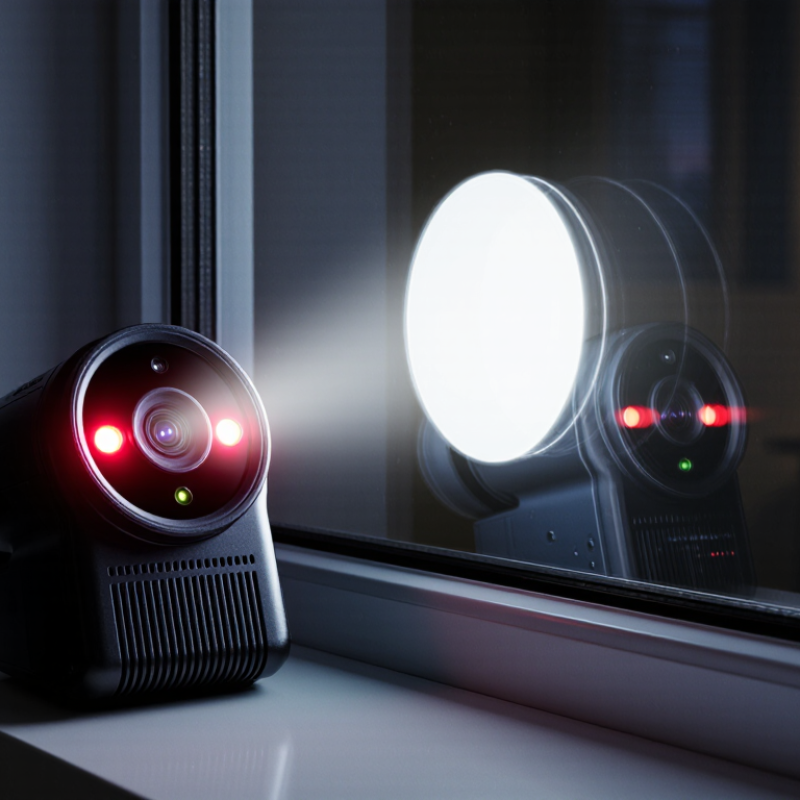
A night vision camera can reflect off a window because its infrared light bounces from the glass surface. At 850–940 nm, the camera emits light that human eyes barely see, but the sensor detects it clearly. The window behaves like a weak mirror, especially when the camera sits close to the glass. Reflected LEDs may appear as bright dots, a glowing ring, or a hazy duplicate image.
Wavelength matters. Around 850 nm, infrared LEDs usually provide stronger sensor response, but a faint red glow may remain visible. Near 940 nm, the light is harder to notice, though many sensors capture less detail. Window coatings, double panes, dirt, and indoor lighting also change the reflection. In practical testing, even a small camera angle can alter the glare. I have found that moving the lens only a few centimeters sometimes improves the image, but this is not guaranteed.
Tips: Keep the camera lens nearly touching the glass, without pressing against it. Turn off nearby indoor lights and clean both glass surfaces. Use a dark cloth around the camera to block stray infrared light. If reflections continue, test a different angle or reduce infrared intensity. Do not assume 940 nm always solves the problem; glass and sensor design vary. A short daytime test can reveal the best position before nighttime recording.
The camera’s infrared light strikes the glass and returns toward the lens. Ordinary glass reflects about 4% of light at each air-glass surface. At night, this small reflection becomes surprisingly visible. The window behaves like a pale mirror.
Yes. Double glazing has several air-glass boundaries. Two main surfaces can reflect nearly 8% of incoming light before other losses. Coatings, thickness, and viewing angle change the exact result.
You may see white rings, haze, glare, or a ghostly indoor scene. The lens cover, curtains, and nearby walls can add extra reflections. Fingerprints make the glass look worse. Small marks matter.
Yes. Around 850 nm, silicon sensors usually detect infrared more easily. This can provide stronger illumination and greater practical range. Around 940 nm, the glow is harder for people to see. However, the sensor may be less sensitive at 940 nm.
Choose around 850 nm for difficult, distant scenes when visibility is acceptable. Choose around 940 nm when a faint red glow is unwanted. Actual performance depends on glass, weather, aperture, and target reflectivity. I would test both, because published range figures can disappoint.
Disable the camera’s infrared illumination for one evening. Check the image after sunset, not only during daylight. If the reflection disappears, infrared was probably the main cause. Some cameras restore infrared automatically, so verify the setting in darkness.
Keep the camera a few centimeters or inches away from the glass. Aim slightly downward or sideways instead of straight through it. Moving the camera only two inches may improve the image. It may not solve everything.
Clean fingerprints and dust from the glass. Turn off indoor lamps near the window. Keep room lights behind the camera, not beside it. A dark hood can block stray reflections. Test several angles while watching live footage. The result may still be imperfect.
Why is my night vision camera reflecting off the window? The most common reason is that the camera’s infrared LEDs illuminate the glass instead of the outdoor scene. Infrared light, typically around 850–940 nm, is partly reflected by each glass surface—about 4% under normal conditions—creating a bright haze, glare, or duplicate image. Reflections become stronger when the camera is close to the window or positioned at an angle, because more emitted light bounces directly back into the lens.
The wavelength also affects performance. Cameras using 850 nm infrared light often provide greater range and stronger sensor response, but the LEDs may show a faint red glow. 940 nm light is less visible and more discreet, though it may offer shorter range or reduced sensitivity. To reduce reflections, disable the camera’s built-in infrared mode when there is enough surrounding light, move the camera away from the glass, or add spacing between the lens and the window. Repositioning the camera to face the glass more directly can also minimize glare.

 AxizView Camera